


Framework for a Stronger Profession
IRPP is more than a credential. It is an ecosystem and practical framework for risk mitigation, succession planning, workforce development, and professional growth. By codifying the critical intersection of policy, finance, and technology, IRPP transitions road pricing from an informal discipline into a structured profession. It helps practitioners navigate their careers by providing independent verification of the core competencies needed to design, deliver, and manage successful road-pricing programs. The IRPP process establishes a clear, recognizable path for professional development at every stage of a practitioner’s career.
Career Growth - Ladder vs. Lattice
Career growth has moved from a rigid ladder to a flexible lattice. Where career progression was once defined by predictable upward steps and job titles within a single hierarchy, today's landscape demands adaptability. Shifting organizational structures, rapid digital transformation, and market volatility require a modern approach, one where growth happens laterally, diagonally, and through expanding personal skill portfolios.
For the road pricing domain, this shift is especially pronounced. Historically, road pricing has functioned more like a guild, an specialized field driven by institutional memory, localized expertise, and learning on the job rather than a defined, standard trajectory. IRPP bridges that gap.
The IRPP Credentialing Program is structured into distinct, progressive tiers designed to meet the evolving needs of the road pricing workforce. Rather than taking a one-size-fits-all approach, IRPP's multi-tiered architecture provides a clear, logical, and transparent trajectory for professional development, no matter where a practitioner enters the field or where they choose to specialize.
Credential Tiers
Tier 1: RPP-Foundation (RPP-F)
Target: Emerging professionals (0-3 years), recent grads, outside professionals entering the domain.
Objective: Verify a comprehensive baseline of competency. Ensure new entrants speak the common language and know fundamentals.
Tier 2: RPP-Practitioner (RPP-P)
Target: Existing, mid-career professionals.
Objective: Validates cross-functional mastery, proving the practitioner can navigate between technology and policy aspects. Mandatory prerequisite for all specializations.
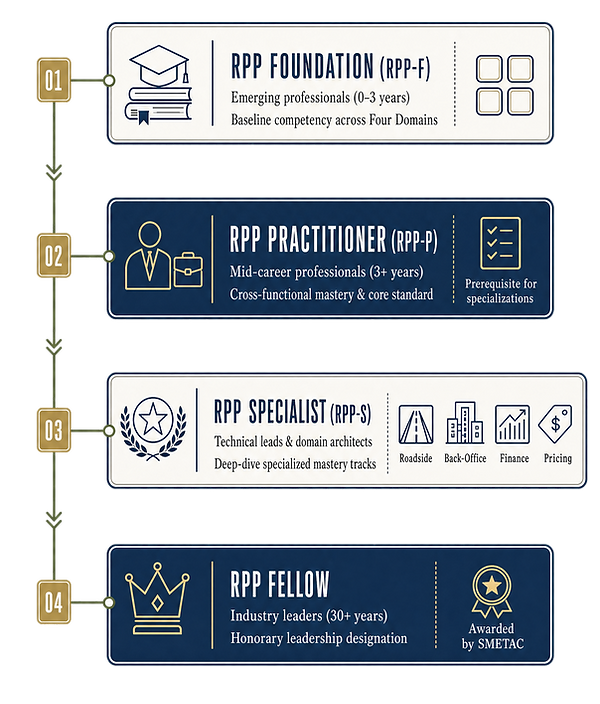
Tier 3: RPP Specialist (RPP-R, B, F, etc.)
Target: Technical leads, policy experts & domain architects who wish to advance in their career.
Objective: Deep-dive validation of select critical specializations (RSS, BOSS, Fin/Pricing/Contracts and Procurement (more TBDby the SMETAC).
Tier 4: RPP Fellow
Target: Long serving industry icons, thought-leaders and legends (30+ years experience).
Objective: An honorary designation awarded by the SMETAC to icons of the domain.
Whether building foundational literacy, advancing through cross-functional leadership roles, or mastering specialized domains, the IRPP tiered framework ensures every practitioner has a recognized roadmap for growth—and every organization has a reliable standard for talent evaluation.
Find Your Entry Point
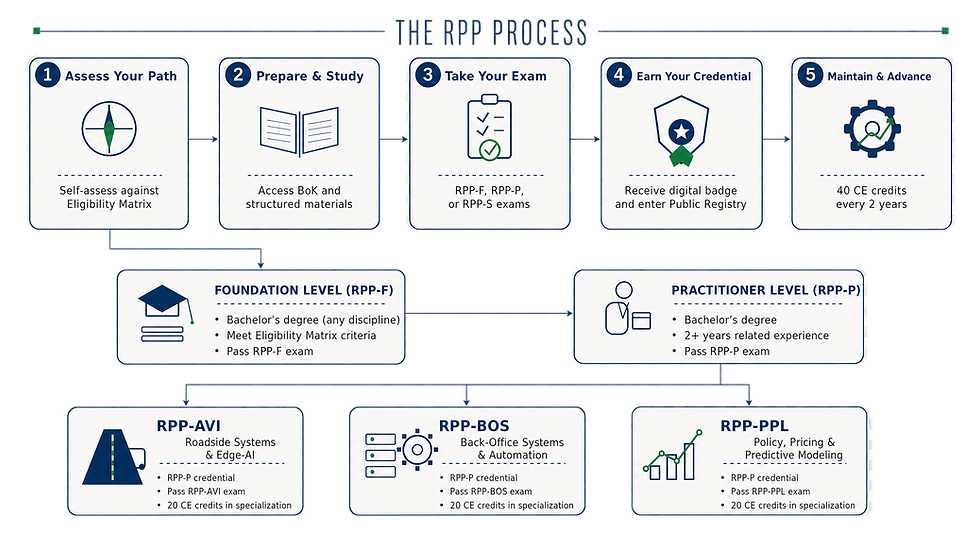
Start by identifying the credential that best matches your education and professional experience. The diagram below will tell you whether Foundation or Practitioner is the appropriate entry point before you begin preparation.
Determine Your Credential Pathway

Preparation is centered on training resources built from the IRPP-Body of Knowledge, with recommended study times ranging from 40 hours for Foundation to 80+ hours for Specialty credentials. It is imperative that the IRPP Body of Knowledge informs training and exam prep materials no matter who delivers the training - IRPP via affiliated training partners, employers, associations, or universities (see more about training here).
What to Expect
Exams are psychometrically validated and proctored via authorized testing centers or secure remote systems.
-
RPP-F: 120+ questions, 2.5 hrs, 40+ prep hours | Focuses on broad domain literacy.
-
RPP-P: 150+ questions, 3 hrs, 60+ prep hours | Focuses on practical application & cross-functional judgment.
-
RPP-S: 120+ questions + case study, 3 hrs, 80+ prep hours | Focus on technical problem-solving.
Upon successful completion, professionals are issued a secure digital badge and a physical certificate and are entered into the Public IRPP Directory, providing employers and agencies with an instant, verified benchmark.
IRPP credential holders must earn Continuing Education (CE) credits every two years and remit a credential renewal fee. This ensures that credentialed professionals stay current with the evolution of the technology and/or legislative and policy changes and IRPP programs have the resources to support the continued evolution of the portfolio.
Maintenance